
Building a GTM Team: The Roles You Need at Each Stage
June 29, 2026
LinkedIn author_name: Patricia Maroto author_link: https://halian.com/insights/author/patricia-maroto
Every founder eventually faces the same question: who do I hire next? When it comes to your go-to-market team, the answer depends entirely on where you are. Hiring a VP of Sales when you have no pipeline is just as costly as trying to scale without one.
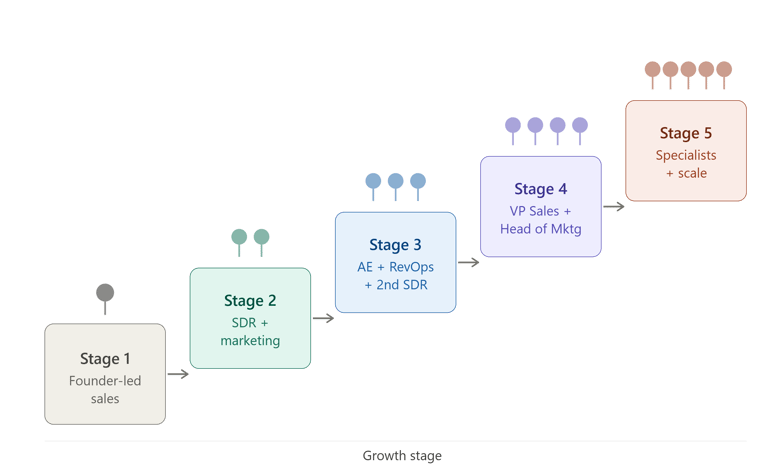
Here is a practical breakdown of the GTM roles you need at each stage of growth — and the order that gives you the best chance of building a revenue engine that works.
Stage 1: Founder-Led Sales (Pre-Revenue to First Customers)
Before you hire anyone, the founder needs to sell. Not because it saves money — although it does — but because no one else can learn the market and validate the value proposition as quickly as the person who built the product.
At this stage your GTM "team" is you and whatever tools you can string together. The goal is not efficiency. It is learning: who has this problem, how do they describe it, and what makes them say yes?
Do not skip this stage. According to a First Round Review analysis of early-stage sales, founders who hand off selling before they understand their buyer almost always have to restart later at much greater cost.
Stage 2: First GTM Hires (Repeatable Revenue Signal)
Once you have a repeatable pattern — a handful of closed deals from a consistent profile of buyer — it is time to make your first dedicated GTM hires. The two roles that create the most leverage at this stage are a Sales Development Representative and a Marketing Generalist.
The SDR takes over outbound prospecting and inbound qualification so the founder can focus on closing and strategy. Look for curiosity, coachability, and resilience over polished experience. If you are unsure how to identify those traits, working with a specialist sales recruiter can save you months of trial and error.
The Marketing Generalist owns demand generation, content, and basic brand presence. They are not running a team; they are building the infrastructure — website, email sequences, social channels, case studies — that will eventually feed a larger machine. A strong marketing hire at this stage is part strategist, part executor, and entirely comfortable working without a playbook. Finding this profile is often easier through a dedicated marketing recruitment partner who understands the difference between a corporate marketer and a startup generalist.
Stage 3: Building the Core Team (Scaling Pipeline)
Revenue is growing and the founder is no longer the only person closing deals. Now the gaps start showing: leads are slipping, follow-ups are inconsistent, and no one is tracking what actually works. This is where you add structure.
The key hires at this stage are an Account Executive, a Revenue Operations lead, and potentially a second SDR. The AE takes over full-cycle closing so the founder can step into a leadership role. The RevOps hire builds the data layer — CRM hygiene, pipeline reporting, conversion analysis — that turns gut-feel decisions into evidence-based ones. If hiring volume is starting to strain your internal capacity, a recruitment process outsourcing model gives you a dedicated talent acquisition function without the fixed cost of building one in-house.
Stage 4: Leadership Layer (Scaling the Team Itself)
Once you have a working GTM engine with multiple contributors, you need someone to run it. This is when you hire your first Head of Sales or VP of Sales, and potentially a Head of Marketing.
The critical mistake at this stage is hiring a "big company" leader who expects infrastructure that does not exist yet. Your first sales leader needs to be a builder, not a maintainer — comfortable coaching reps, redesigning pipeline stages, and still jumping on a call when a deal needs saving.
For these senior hires the stakes are high and the margin for error is thin. An executive search process gives you access to passive candidates — experienced leaders who are not browsing job boards but would move for the right opportunity.
Stage 5: Specialists and Scale
With leadership in place and revenue predictable, you start adding specialists: Customer Success Managers to protect existing accounts, Product Marketing Managers to sharpen positioning, Sales Enablement leads to onboard new reps faster, and Partnership Managers to open indirect channels.
At this stage the hiring challenge shifts from finding the right person to finding them fast enough. Every open seat is a bottleneck in the revenue plan. This is where having a long-term recruitment partner who already understands your culture, your buyer, and your competitive landscape becomes a genuine strategic advantage.
The Bottom Line
Building a GTM team is not about filling an org chart. It is about sequencing the right roles at the right time so each hire compounds the impact of the last. Get the order wrong and you burn cash. Get it right and you build a machine that scales with you.
If you are planning your next GTM hire, talk to our recruitment specialists — we help companies build high-performing sales and marketing teams every day.
About the author